Cannabis Price Indexing: Understanding Comparisons
As the green rush matures and consolidates, operators are starting to wake up to a hard truth: you can’t run a modern retail operation without a grip on your pricing strategy. One of the most powerful—but often misunderstood—tools in that arsenal is price indexing.
What Is Price Indexing?
At its core, price indexing is nothing more than comparing your store’s pricing to competitors. Think of it like checking the menu down the street and asking yourself: Are we too high? Too low? Right on the money? But when you scale that process from a single store to 10, 50, or 100+ locations across multiple states, it quickly becomes a monster.
The Old-School Way: Walk, Write, Repeat
Traditionally, this has been a footwork job. Store managers or junior staff are tasked with visiting neighboring shops, taking photos or notes of menu boards, then manually inputting the data into some janky spreadsheet. It’s an ugly, analog process that works—until it doesn’t.
Let’s say you’ve got 100 stores. Each one sends out 2 employees at $20/hour for 10 hours to check five nearby competitors. That’s:
2 employees × $20/hr × 10 hrs = $400 per store
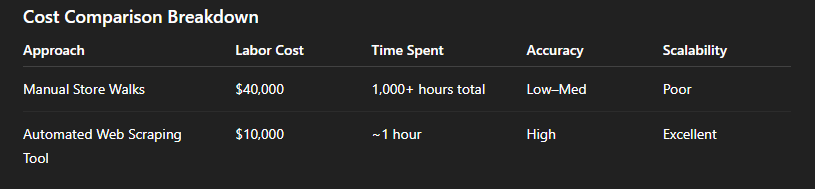
$400 × 100 stores = $40,000 in labor costs per price sweep
And that’s just the first pass. Forget about how accurate the data is, or how quickly it gets outdated. You’re also betting that every employee records product weights, tax inclusions, and discounts consistently. Spoiler: they don’t.
The Better Way: Automation, AI, and Web Scraping
Now take that same 100-store chain and instead of street-level recon, you deploy a centralized data analyst with a scraping tool or AI service that pulls menu data from public e-commerce menus (Dutchie, Weedmaps, Jane, etc.), normalizes the data (SKUs, weights, prices), and generates indexed dashboards.
1 analyst × $100/location for a scraping/reporting tool = $10,000
Time spent: ~1 hour to run + QA the report
You just cut costs by 75% and got better data. Plus, you can run it weekly—or even daily—without sending anyone out. Now you’ve got pricing visibility across 500 competitors, not just 5. And you didn’t burn your entire ops team’s schedule to get there.
Cost Comparison Breakdown
Why This Matters
In a market where margins are thin, and loyalty is driven by price and availability, having real-time visibility into your competitors' pricing isn’t optional—it’s survival. Web scraping and automation isn’t some hacker trick anymore. It’s table stakes. Especially when product categories like vapes, flower, and edibles all have volatile pricing structures.
And here’s the kicker—AI doesn’t sleep. It doesn’t need PTO. And when trained right, it doesn’t miss product weights or mistake pre-tax for post-tax.
Final Hit
If you’re still sending out employees with notepads and clipboards to spy on the shop across the street, you’re playing checkers in a chess game. The future of price indexing is automated, accurate, and affordable. The sooner you embrace that, the sooner your margins start breathing again.