Selling Blind: CCD FAQ Sheet Raises More Questions
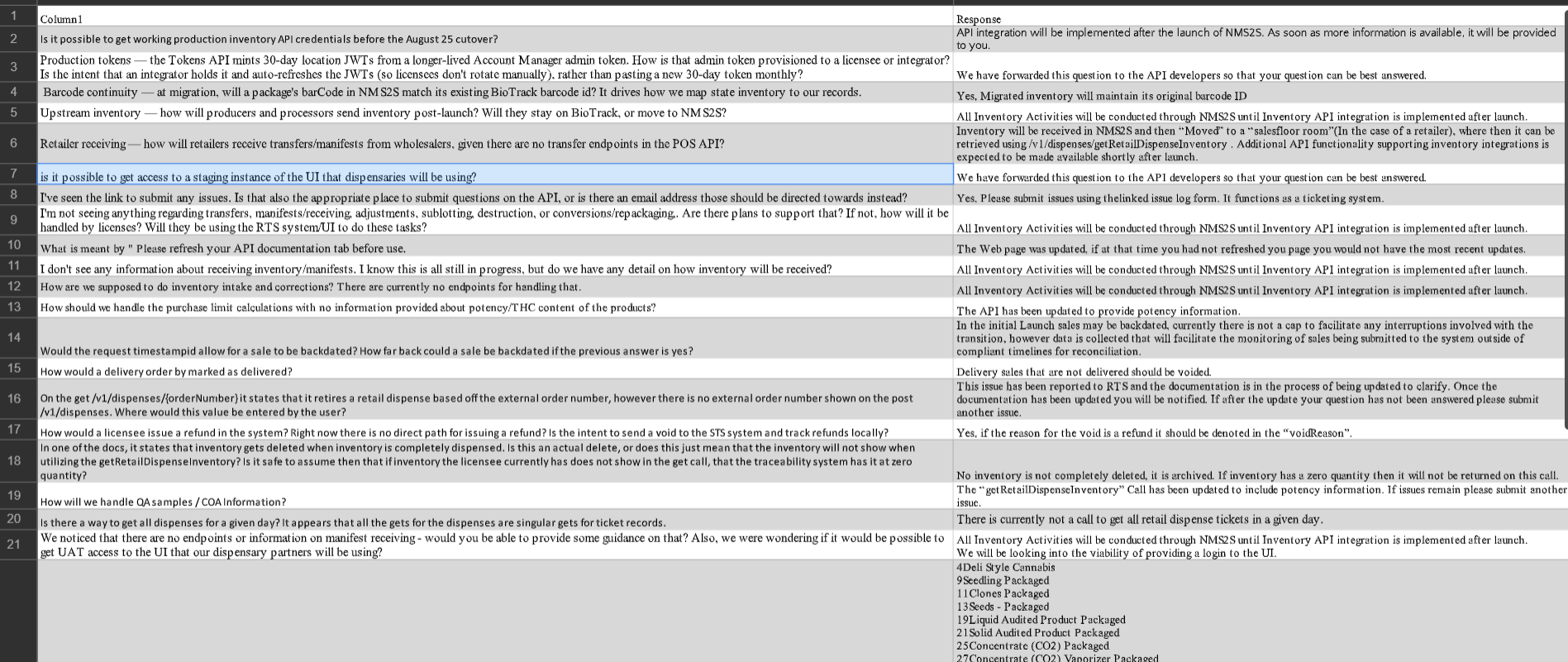
The New Mexico CCD sent out an API FAQ Sheet late Friday evening to help answer some of the questions many operators and integrators have been asking. But while the goal was clearly to provide some clarity, it may have created even more questions.
Bare Barcodes
The BioTrack IDs are now called barcodes. They are still 16 digits and will not change after migration. However, one thing noticed during testing is that there is now no space between every four digits. This is important for those who work with data in Excel or Sheets. Disable scientific notation in Excel or convert the column to text to avoid the 16-digit barcode being converted to scientific notation.
Instant Transmission
This is one of the more important answers in the FAQ. CCD says all inventory activities will be conducted through NMS2S until the Inventory API integration is implemented after launch. For retailers, they get more specific; inventory will be received in NMS2S and then “Moved” to a “salesfloor room.” Once there, the POS can retrieve it through getRetailDispenseInventory.
So regardless of whether your POS provider has its inventory integration ready on day one, there appears to be a mechanism for getting inventory in and out of the state system. This is where it gets messy.
Double Trouble
If there is no manifest integration at launch, an operator may need to receive the transfer in NMS2S first, move it to the salesfloor, and then separately create or receive the corresponding PO in their POS so the local inventory matches the state inventory, no different than what alot of early adopters of Cova had to do.
This is an inference based on experience, not something CCD explicitly says in the FAQ. But the FAQ does explicitly says that broader inventory API functionality isn't coming until after launch. A big problem for some systems is the way manifests are sent and received. Even now, some Dutchie users need to manually pull manifests back through the BioTrack portal to correct them.
So what happens when all of this has to be ironed out again?
Between Planes
Here's one the FAQ doesn't answer: What happens to any manifests that have been transferred but not received? Not just the important stuff, but the leftovers. You know all those manifests of random samples people have sent your stores? The ones you never ordered, that have just been sitting there for years? Is this a good chance to just let those go away?
The migration rules for open transfers, partially resolved transfers, rejected manifests and other lingering records matter almost as much as the migration of current on-hand inventory. The FAQ confirms barcode continuity, but it doesn't explain the lifecycle of those outstanding records. Obviously there is an expectation to address those at some point, but with just two weeks left, those lingering manifest might be the last thing operators are concerned with.
Some Type Of Way…
The FAQ also provides the state's supported inventory-type list, and there are some interesting distinctions in it. Concentrates aren't simply concentrates. The list distinguishes CO2, non-volatile solvent and volatile solvent products, and then carries those classifications into packaged variants. That's considerably more specific than many operators are accustomed to seeing. It also raises another question: what determines the classification when a finished product has multiple processing steps?
For example, assuming that means the difference between kief, or disti ran from BHO, what if a final product has both? volatile/non-volatile generally describes the solvent/process category, and the FAQ itself doesn't provide definitions or a hierarchy for determining which inventory type wins when multiple processes are involved.
Preseason Drills
While a lot of operators have spent the last several years calling the current traceability system “BioTrash,” a large number are now calling for a pause on the rollout, fearing complications especially with harvest season nearing. And they might have a point for several reasons. Imagine you’re an operator who went on vacation August 1st, and won’t be back to check your emails until August 26th. You’re gonna be pissed. On top of that, there are still major service providers who haven’t even applied for UAT testing yet.
CCD is already talking about outages, but what happens if the whole system doesn’t come back. Would the CCD allow operators to continue operating and self report from there current systems, the same way New York operators did for a period of time before going to METRC. I mean BioTrack. I mean METRC. (Guess it’s not just our state…). In that scenario, the smaller operation with a single system can quickly pivot and keep trucking.
Now imagine you have several grows, and several stores, all running on several different systems. Several employees use a mix of them, if not all. They all need new passwords. They all need access. And they all need it at once.
Those aren’t theoretical data questions anymore. They’re operational nightmares.
Mr. Democracy
Truth be told, the FAQ did not make me feel warm and fuzzy. In FAQ, it made my anxiety flare enough to write this article.
The hopeless optimist in me wants to be believe that the new system will be so good, with all the best features, from all your current systems, and it will be so good that you’ll cancel your other contracts, and save lots of time and money.
In corporate terms, what is more likely to happen is that an entire state is being required to transition to a new system and establish new workflows with new technology partners. As with any transition of this scale, operators should anticipate some unexpected periods of disruption as systems, integrations, and processes are tested in a live environment.
In simple words: Buckle up, butter cup - This could be a bumpy ride.