Trichomes & You: Anatomy Of A Trichome
Trichomes: The Business End of the Plant
Every conversation about flower quality, aroma, or concentrates eventually circles back to the same microscopic structure most people can’t define: the trichome. It’s wild how often decisions worth millions of dollars get made in rooms where no one can explain what a trichome head actually is.
What trichomes are
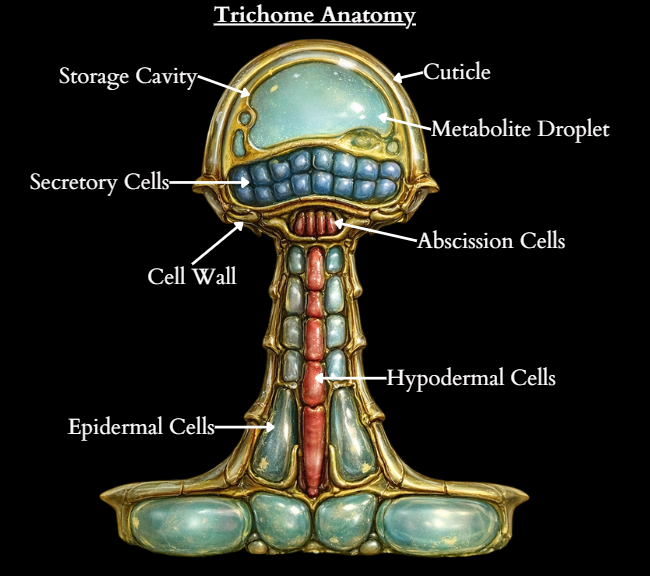
Trichomes are specialized structures that grow from the outer layer of the plant’s surface. On flower, the ones that matter most are glandular, capitate-stalked trichomes—a stalk topped with a swollen head that looks like a glass mushroom under magnification.
That head isn’t decoration. It’s a self-contained biochemical factory.
How trichomes form
Each trichome starts as a protodermal cell, a basic epidermal cell that commits to a different path. Through a precise sequence of divisions, that cell differentiates into three main components:
Stalk cells, which lift the head away from the plant surface
Abscission cells, which form a narrow constriction between stalk and head
Secretory disc cells, packed into the head itself
This structure isn’t accidental. It’s engineered.
The secretory disc: where production begins
Inside the trichome head, the secretory disc cells form what’s called a syncytium—a network of cells that behave as one functional unit. These cells handle the heavy metabolic work: producing cannabinoid and terpene precursors, coordinating transport, and feeding the system.
This is where CBGA, the central cannabinoid precursor, is synthesized. Think of it as raw material, not the finished product.
Why the final product isn’t made inside the cells
Here’s where things get interesting.
Evidence shows that the final enzymatic step of THCA formation does not occur inside the secretory cells. Instead, CBGA is exported out of those cells into the storage cavity—an inflated, extracellular compartment at the top of the trichome head.
Once there, CBGA encounters cannabinoid synthase enzymes that complete the conversion.
Why outsource the final step?
Because cannabinoids are toxic to the very cells that make them.
Studies have shown these compounds can disrupt mitochondria and damage cellular function. If they accumulated inside the secretory cells, the plant would shut down its own production line. The solution is elegant: make the product inside, finish it outside, and store it in a sealed space that doesn’t kill the workers.
The storage cavity: containment, not convenience
The storage cavity is part of the apoplast—the space outside cell membranes that includes cell walls and intercellular gaps. It allows compounds to accumulate without crossing back into living tissue.
This setup minimizes self-damage, preserves metabolic efficiency, and explains why physical damage, heat, or agitation to trichome heads has such outsized effects on quality and yield.
The unsolved part
One key detail remains unresolved: how cannabinoids and terpenes cross the plasma membrane from the secretory disc into the storage cavity. The transport mechanism is still unknown. That gap matters, especially for anyone trying to manipulate yield, expression, or post-harvest handling.
Why this matters
Trichomes aren’t cosmetic. They aren’t dust. They’re not just “frost.”
They are purpose-built biological factories designed to produce, isolate, and store compounds that would otherwise destroy the cells that create them. Understanding that changes how you think about cultivation, handling, extraction, and even pricing.
If you don’t understand trichomes, you don’t understand flower.
And if you’re investing, buying, or building without that knowledge, you’re guessing.